"An expert is a man who has made all the mistakes which can be made, in a narrow field."

- Niels Henrik David Bohr
Showing posts with label Weekend thoughts. Show all posts

Sunday, November 21, 2010

Weekend Edition (11-20-2010)

I have noticed that I have at least two bad entry habits that consistently eat into the daily profits:

  • Entering on a non-moving stock
  • Exiting early on a big trend and trying to reverse

I decided to spend part of the weekend trying to come up with an approach that would reduce my tendency to trade those types of price environments. While realizing the problem over the last week or so, and trying to figure out a solution, it became painfully obvious that my current simple/naive approach to establishing entries/exits doesn't offer much in the way of discretionary tools.

I thought about it. And thought about it some more. And then I decided that I really needed to come up with  an objective and quantifiable 'something or other' as an indicator of the current price environment. Something to give me the 'green light' to look for an entry.

So I came up with two ideas - one addressing my psychological framework, and one addressing my technical framework.

As to the psychological framework


This is the most important thought of the weekend.

I feel that I need to be ready to admit that I cannot trade like Scott; as much as I would like to be able to, and hopefully eventually will be able to, it is way beyond my current skill level. Scott has an amazing sense for the trade, honed by years of experience and an ability to focus. Sometimes I do very well reading momo, but there are enough times (as evidenced over the last few weeks of live trading) where I fall pretty flat and rapidly cut into my profits

After I stopped to think about some of this, I was surprised at how often 'pretending to be as good as Scott' gives me permission to make some entries. What I mean to say is he is able to time exits and reversals so un-canningly perfect at times that I think I should be able to as well: 'This looks right, I am just going to go for it and see what happens.' In a way, admitting this is about giving myself permission to slow down, lowering some immediate expectations, and taking more time and thought to analyze/observe price environments.

As to the technical framework


I wanted to keep this as simple and naive as possible. In a nutshell - I decided to go with the trend and the big movers. I am going to limit trades to big movers and use the color of the MA's on both the short and longer ranges as the quantifiable measure of the trend.


Entries
  • Do not trade prior to 10:00 a.m. ET.
  • Limit trades to the 5 stocks with the highest ATR values.
  • Only trade in the color direction of both the short and long range charts (blue is long, red is short)
    • Enter when the price crosses the short range MA, with the color of the short range MA matching the long range MA
    • Watch for end of trend signals:
      • Extremely high/low volumes, wave count (5/3 wave)
  • Place stops on the closest prior S/R


Exits

  • Draw lines from the start of the move to the top/bottom of the first correction for exits
    • Draw a new line if the slope of the trend changes
    • Exit when a bar on the dominating chart closes below the line 
  • Watch for end of trend signals:
    • Extremely high/low volumes, wave count (5/3 wave)

Here is an example of a legitimate trade on AAPL: 


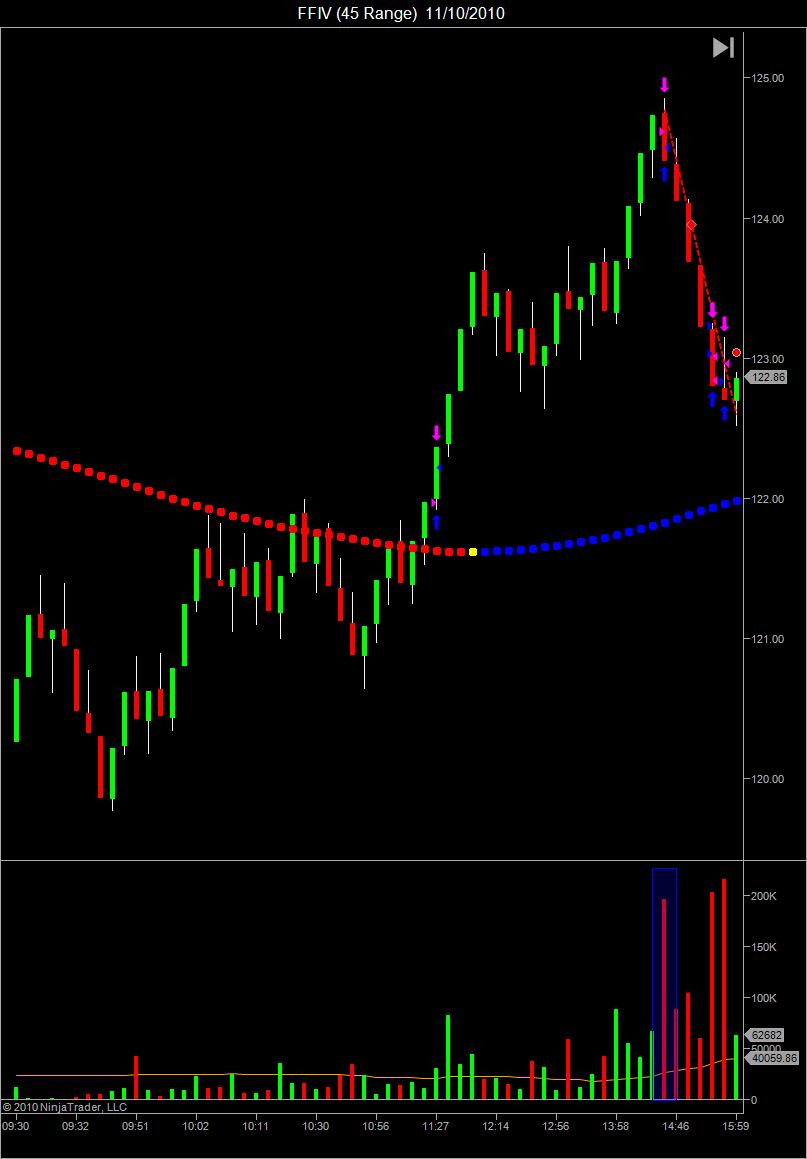
Yellow lines are the wave count, red lines are exit lines, red diamond is entry, red dot is exit. Here is the setup on the 20 range (which, in my current setup is the shorter of the two range bars):

Entry:


Exit:


For a quick comparison - here are my trades on the 45 for the same day:


The same initial entry, but only one rather than 6 - only 3 of which did not get stopped out.


Reversals (i.e., trading against color on the larger range)

  • Only trade against color on the larger range when there is extreme high/low volume changes on the shorter range, and after the shorter range crosses the MA.

Here is a legitimate reversal on AAPL (11-16-2010)


Entry (note extreme volume at LOD):


Exit:


How This Compares


I picked two days worth of trades over that last couple of weeks: 11-10-2010 (i.e., the biggest losing day) and 11-16-2010 9the biggest winning day). I assumed that I would of been watching the same stocks and entered accordingly.

11/10/2010

There were no trades on TNA, RIMM, BIDU, SOHU,  PEGA, or GS using the probability criteria.

AAPL:

This was probably the most problematic of the bunch - especially with respect tot he 5/3 wave configuration. I kept the basic rules - and decided that the start of the new wave had to have at least 2 candles closing below the low of the peaking candle (of course it would be the opposite in a down trend).

The entry is at the start of wave 4 on the 45.


AIZ


CF


CMG


FFIV


NFLX

Two trades on NFLX.


Trade 1:


Trade 2 entry:


Trade 2 exit:


 PCP


2 stops on 8 trades, 6 trades were very profitable; compared to what NT calls 53 entries and exits.Of course this is no guarantee of what I would of actually done, but it is about as close as I can get.

11/16/2010

AAPL

Two trades on AAPL.

Again the 5/3 wave definition was a little problematic - but the fuscia line holds as wave 3 cannot be the shortest. Two of the corrective waves are on the verge of not being corrective at all, so it could of gone either way.


Trade 1:


Trade 2:


BIDU


CMG

Two trades on CMG.


Trade 1:


Trade 2 - stopped:


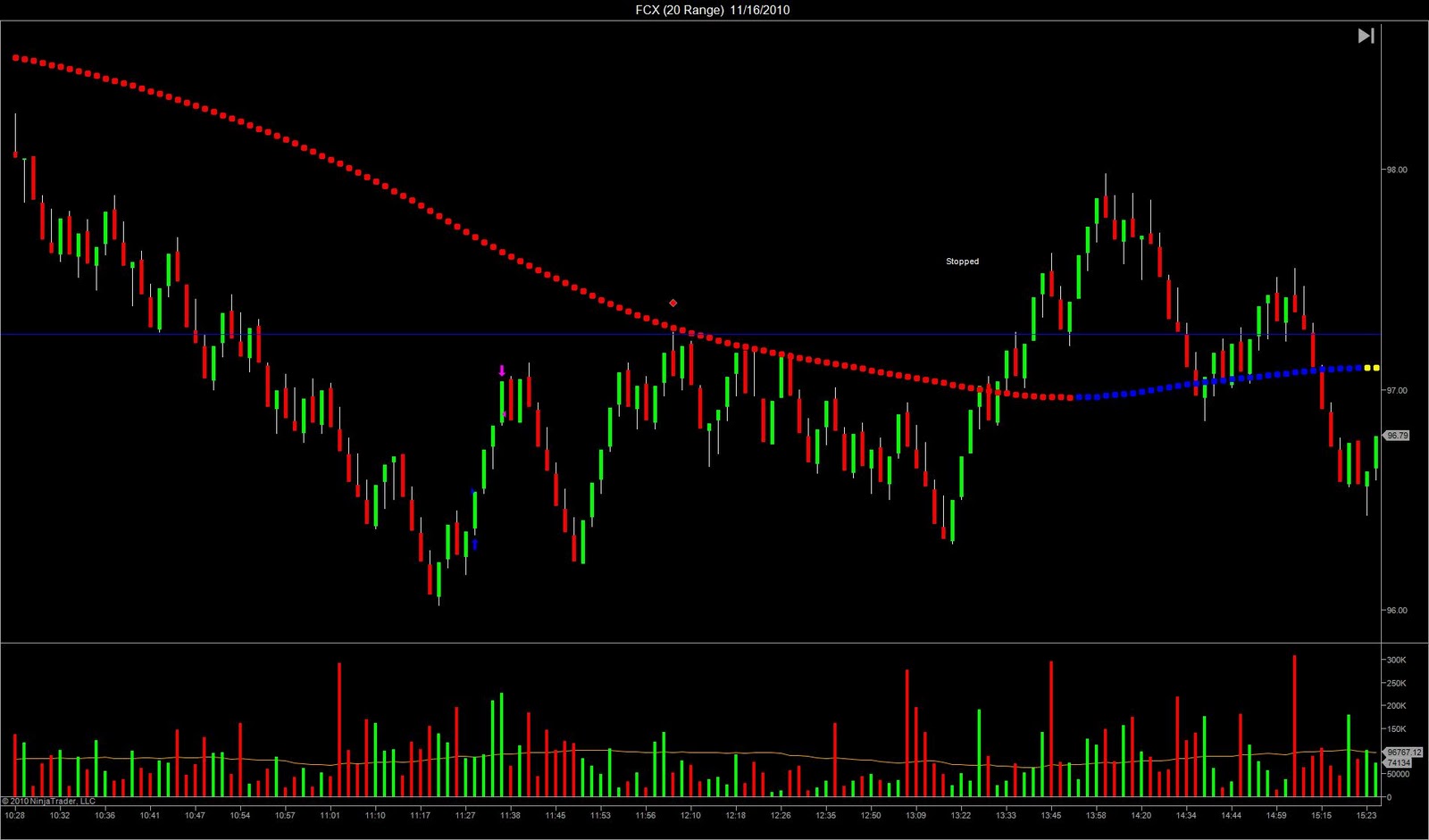
FCX


6 trades with 3 stops - but well over double the actual profit.

Final Thoughts


So far so good.

The bad thing? Well, perhaps not bad, but it was a little frustrating to realize that this is going to keep me out of some relatively big moves. For sure I have to be ok with this - I am coming to realize that missing big moves is likely and is not the end of the world. For now I have decided to accept that those moves and potential entry points are less probable.

Another question that comes to mind - what does this mean for my future as a trader? Am I limiting myself? Am I relying too much on indicators? Will this keep me from nurturing and relying upon my instinct?

I am not really sure. My hope is that this approach will make it 'safe enough' to continue to observe and learn. For the most part, the ability to grow my intuitive skills will have more to do with my attitude and how I see the 'technical framework': is this about safety and defining probabilities or is this about a rigid and conclusive methodology?

I have decided to 'test' this approach by trading live. As is evident from the two day review and the sometimes identical entries, this framework is a 'narrowing' of my current approach rather than a completely new ball of wax. The 'test' will mostly be about me and my ability to implement the trades with some degree of efficiency; i.e., trading the plan without exception. This will be the hardest part - and why I needed to address the psychological framework as well. Though it might sound a little silly, giving myself permission to be safe, lower my current expectations, and to continue to grow and learn, is a big step in the right direction.

Feedback appreciated.

Trade well.

Monday, June 7, 2010

Weekend Perspective

Been a great and relaxing weekend thus far - made better by Scott's new mp3.

I have to admit, I was familiar with some of Scott's earlier affirmation/zen mp3's but I never got around to listening to them. I downloaded one several months back, but didn't listen to the entire thing. Personally, I thought it might work for some people, but for me it was mostly mombo jumbo. And it had something to do with my approach to trading at the time: more about technical analysis... and hope... and fear. Good grief I am glad I am out of the swing trade/overnight nightmare routine.

I have changed my approach to the markets and trading over the last three months, thanks in large part to what I have come across in the blog-sphere (and which I started acknowledging somewhere around here). This has been and is significant in a lot of ways.

Over the years I have tried several different approaches to trading. For years I was convinced that the only way thru the mess was fundamental analysis though the required work never appealed to me. When I took up trading again last spring, my approach was about being clever - about using my background in engineering and optimization to analyze price activity and find the 'secret' recipe. My training was my edge and I tried very hard, very, very hard, to pin this thing down. After numerous approaches, a lot of energy, and 'educational investment' (i.e. loss of trading capital), my trading was best characterized as gut wrenching hope and fear based nail biting 'is-it-going-to-work-this-time' sessions. Somewhere along the line I started recognizing that understanding the technical analysis was a very small part of the equation; what was going on inside my head over the course of the trade was far more important.

Occasionally I ran across another kind of trade: different, out of method entries on moving stocks and exited promptly for nice profits. These just felt right, I recognized that the trades were more about movement and less about finding the right technical indicator (not that I didn't still try to find something special that would do the trick), but I didn't really understand what was going on. Until I re-visited FNG during some down time. I started reading and couldn't stop. The more I read, the more I identified with what Scott was writing about, the good , the bad, and the ugly.

Since then the trading education journey has been about getting away from what I have been trained as an engineer to do: simulate, analyze, predict, and then build/act accordingly. In many respects the journey has been about getting away from the need to control. I am not sure that I can adequately explain how big of a step this is.

I have been trained to look at data and find patterns. This works very well for certain types of data, even a lot random types of data: name the distribution and you can quantify the probability. The lure of prediction is control, and control is power, especially as it pertains to the financial markets.

Pfft...

I have had to learn that the markets are absolutely beyond control: absolutely anything can happen at absolutely any time. As concrete and explicit as price activity and data are, stock market science is more a social discipline than a physical discipline. About human nature rather than some rational causality. I wasn't using the right tools for the job. No mathematical model can predict what I am going to be thinking or how I am going to respond to what is happening around me; much less predict how a few million other people will try to outsmart each other. It is one thing to acknowledge market randomness, and another to understand the degree of randomness inherent in the markets.

The interface is simple: a price and number of shares trading at that price over time (no manner of measuring, transforming, tweaking, complicating or awe-inspiring labeling can change this). But the interaction - millions of people trying to negotiate a fair price for the commodity - is incredibly dynamic and complex.

The best tool for the job is me: my knowledge of myself, my familiarity with human nature, my gut reaction to the moment. No amount of processing power can even come close to the amount of information that I can receive and react to. My job is to train myself to respond correctly to the moment.

How can I explain this? This is my edge: the ability to respond to what the market is doing in the moment.This can only come from intense concentration and focus and confidence. I sound like I am just re-iterating what FNG say's, but I am not. Again - it is one thing to read this stuff - I read it for the first time months ago - and it is entirely another to stake ownership and say what I personally believe to be true. It is like a light coming on - 'Oh yeah, that is what that meant'. Wisdom may preclude the hard lessons, but I am not so wise; my lessons tend to be long drawn out and difficult affairs. More like a branding iron than an intellectual exercise.

That is where I am at right now in my trading experience. I need to work on my ability to focus and respond with confidence. And I think Scott's meditation tool is incredibly effective, at least in the confidence department (which I think is key to the trading, but next week will tell). If you haven't tried it out, I say give it a go. If it doesn't click for you now, keep it handy for sometime in the future. Amazing the resource Scott's blogs are.

So - next week.

I feel like I am constantly tweaking my approach, but it is what it is.

The goal this week is to trade well: keep focused on the market and to trade confidently.

Thinking some more about last week (and weeks prior for that matter), I have a tendency to try and finish the day strong, especially if the day's performance has not been that great. I think this is part of what was contributing to TNA's EOD trades on Friday. I am not going to say that I can't trade the last 15 minutes of the day, but I want to avoid just trying to get lucky. Part of this may stem from glancing at the day's PnL and thus setting up the performance standard, which paper trading hasn't been that good for. So no more PnL, even while paper trading.

I am going to kick the trade lots up to 500 shares. And - I am going to remove the trailing stop. I feel like I need to develop my concentration and market reading skills, and I think that depending on the trailing stop will offer an excuse to lose focus (i.e., be lazy).

But - NT has a pretty cool 'shadow' strategy feature that I can use to track performance differences. So I will set the shadow strategy up with trailing stops and see how everything comes out by week's end.

And I will be paper trading for a bit yet. Not sure about the time line, but I want to get some 'in the zone' consistency before returning to live trading.

Trade well.

Sunday, May 16, 2010

Weekend thoughts

After reading Eric Chung's entry today, I felt inspired to update my personal approach to trading and change the blog up a little. I added pages via the new page function at the top of the blog for navigation, and am reserving the right column links for great trading material that I find on the internet (FNG dominates at the moment lol). All the pages saw small changes, but Entering and Exiting a Position saw the most - primarily to do with the emotional aspect of this business.

The weekend has offered a respite from last week, and some perspective.  I have spent some time coming to grips with what happened last week - inside of me, inside of my head. As I was writing Friday's EOD review, I noticed that there was a lot of movement in the stocks I had been trading. Movement that in several cases I just watched. Why?

Because I was afraid. Monday wasn't too bad, end of day I felt a little numb, but I recovered. Then after realizing virtually the same dollar figure loss on Tuesday, I was beat. I tried to tell myself that I wasn't, but I was, and I think it affected my trading the rest of the week. I was not concentrated on the market, I was concentrated on how I felt and wondering if I could make it up by week's end. I don't have enough energy and/or resources for my emotions while I am trading. As Scott says over and over again, charts are easy, green means up, red means down. Sometimes you pick the wrong side. Get busy getting on the right side.

I know I can do this. Not in some empty self flattering, self convincing, will power type of way, I really know this. I look at the charts from last week, even Tuesdays, and I see the movement. It is there. I may get in on the wrong side, but I can easily change sides. Or I will get in on the right side next time. The only thing keeping me from doing that was/is fear.

That fear has a lot to do with the account balance. I thought I was able to maintain some type of balance - only looking occasionally, or looking to see how good the exits were on the bid/ask. Doesn't work for me. I have decided I am not looking at it any more. Not once during the day. Not when I take a break, not if I wonder how much slip occurred on the trade, not when I had an especially long run. Not even after 12 stops in a row. It is not going to happen till end of day. I am in the day to trade the market as well as I can. Every trade is a new trade.

Oh yeah, and I decided to go live Monday.

Meaning I may have to set up a donation button by end week lol.

Best of luck next week guys/gals!

Thanks too to the Fozz - for sharing this great read.