Nassin Nicholas Taleb (the author of The Black Swan: Second Edition: The Impact of the Highly Improbable: With a new section: "On Robustness and Fragility"
 ) shares some interesting insights with respect to knowledge and information. As it turns out, too much information tends to cloud judgment and detract from the decision making process.
Case in point:
"Show two groups of people a blurry image of a fire hydrant, blurry enough for them not to recognize what it is. For one group, increase the resolution slowly, in ten steps. For the second, do it faster, in five steps. Stop at a point where both groups have been presented an identical image and ask each of them to identify what they see. The members of the group that saw fewer intermediate steps are likely to recognize the hydrant much faster. Moral? The more information you give someone, the more hypotheses they will formulate along the way, and the worse off they will be. They see more random noise and mistake it for information." (Emphasis added.)
Basically, the problem is that ideas tend to be sticky - we make up our mind about something and tend to avoid changing our minds. Those who delay in making the decision (within some guidelines of course) tend to make better decisions. Interestingly enough, after we make a decision, new information only tends to re-enforce our initial decision rather than change our minds.
A good example of this was yesterday's TNA action: I kept reading and judging within the 5 minute candle. It then didn't matter what the candle turned out to be, I saw the rally weakening. And I kept trading it as such.
And this morning on my POT trade:
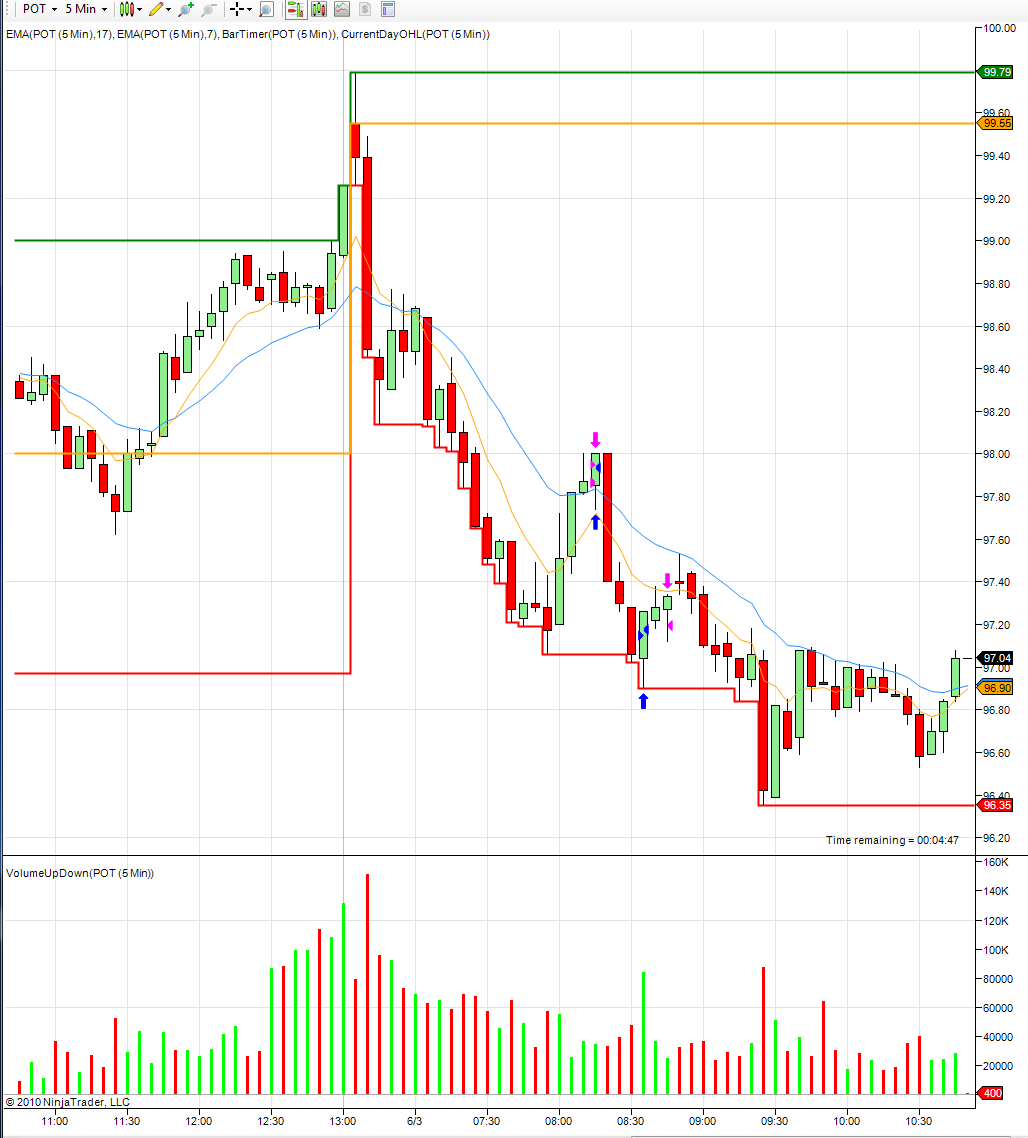
The mistake happened on the long - exiting at almost the worst possible moment, and prior to the candle finish. Because of what I thought the candle was saying mid-stream.
Lesson? Try to avoid making a decision on intra-candle play.
I am not sure how all of that works out, but that will be my goal for the afternoon.
Trade well.

