"An expert is a man who has made all the mistakes which can be made, in a narrow field."

- Niels Henrik David Bohr
Showing posts with label progress. Show all posts

Sunday, November 21, 2010

Weekend Edition (11-20-2010)

I have noticed that I have at least two bad entry habits that consistently eat into the daily profits:

  • Entering on a non-moving stock
  • Exiting early on a big trend and trying to reverse

I decided to spend part of the weekend trying to come up with an approach that would reduce my tendency to trade those types of price environments. While realizing the problem over the last week or so, and trying to figure out a solution, it became painfully obvious that my current simple/naive approach to establishing entries/exits doesn't offer much in the way of discretionary tools.

I thought about it. And thought about it some more. And then I decided that I really needed to come up with  an objective and quantifiable 'something or other' as an indicator of the current price environment. Something to give me the 'green light' to look for an entry.

So I came up with two ideas - one addressing my psychological framework, and one addressing my technical framework.

As to the psychological framework


This is the most important thought of the weekend.

I feel that I need to be ready to admit that I cannot trade like Scott; as much as I would like to be able to, and hopefully eventually will be able to, it is way beyond my current skill level. Scott has an amazing sense for the trade, honed by years of experience and an ability to focus. Sometimes I do very well reading momo, but there are enough times (as evidenced over the last few weeks of live trading) where I fall pretty flat and rapidly cut into my profits

After I stopped to think about some of this, I was surprised at how often 'pretending to be as good as Scott' gives me permission to make some entries. What I mean to say is he is able to time exits and reversals so un-canningly perfect at times that I think I should be able to as well: 'This looks right, I am just going to go for it and see what happens.' In a way, admitting this is about giving myself permission to slow down, lowering some immediate expectations, and taking more time and thought to analyze/observe price environments.

As to the technical framework


I wanted to keep this as simple and naive as possible. In a nutshell - I decided to go with the trend and the big movers. I am going to limit trades to big movers and use the color of the MA's on both the short and longer ranges as the quantifiable measure of the trend.


Entries
  • Do not trade prior to 10:00 a.m. ET.
  • Limit trades to the 5 stocks with the highest ATR values.
  • Only trade in the color direction of both the short and long range charts (blue is long, red is short)
    • Enter when the price crosses the short range MA, with the color of the short range MA matching the long range MA
    • Watch for end of trend signals:
      • Extremely high/low volumes, wave count (5/3 wave)
  • Place stops on the closest prior S/R


Exits

  • Draw lines from the start of the move to the top/bottom of the first correction for exits
    • Draw a new line if the slope of the trend changes
    • Exit when a bar on the dominating chart closes below the line 
  • Watch for end of trend signals:
    • Extremely high/low volumes, wave count (5/3 wave)

Here is an example of a legitimate trade on AAPL: 


Yellow lines are the wave count, red lines are exit lines, red diamond is entry, red dot is exit. Here is the setup on the 20 range (which, in my current setup is the shorter of the two range bars):

Entry:


Exit:


For a quick comparison - here are my trades on the 45 for the same day:


The same initial entry, but only one rather than 6 - only 3 of which did not get stopped out.


Reversals (i.e., trading against color on the larger range)

  • Only trade against color on the larger range when there is extreme high/low volume changes on the shorter range, and after the shorter range crosses the MA.

Here is a legitimate reversal on AAPL (11-16-2010)


Entry (note extreme volume at LOD):


Exit:


How This Compares


I picked two days worth of trades over that last couple of weeks: 11-10-2010 (i.e., the biggest losing day) and 11-16-2010 9the biggest winning day). I assumed that I would of been watching the same stocks and entered accordingly.

11/10/2010

There were no trades on TNA, RIMM, BIDU, SOHU,  PEGA, or GS using the probability criteria.

AAPL:

This was probably the most problematic of the bunch - especially with respect tot he 5/3 wave configuration. I kept the basic rules - and decided that the start of the new wave had to have at least 2 candles closing below the low of the peaking candle (of course it would be the opposite in a down trend).

The entry is at the start of wave 4 on the 45.


AIZ


CF


CMG


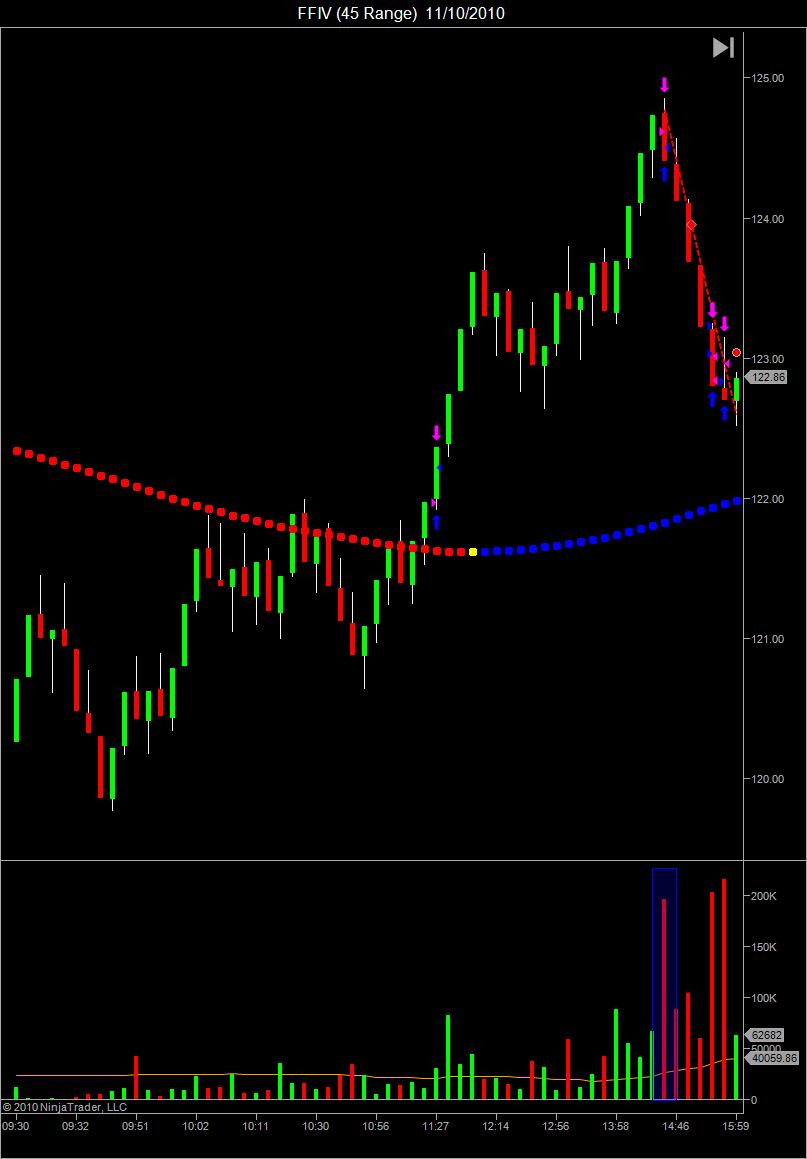
FFIV


NFLX

Two trades on NFLX.


Trade 1:


Trade 2 entry:


Trade 2 exit:


 PCP


2 stops on 8 trades, 6 trades were very profitable; compared to what NT calls 53 entries and exits.Of course this is no guarantee of what I would of actually done, but it is about as close as I can get.

11/16/2010

AAPL

Two trades on AAPL.

Again the 5/3 wave definition was a little problematic - but the fuscia line holds as wave 3 cannot be the shortest. Two of the corrective waves are on the verge of not being corrective at all, so it could of gone either way.


Trade 1:


Trade 2:


BIDU


CMG

Two trades on CMG.


Trade 1:


Trade 2 - stopped:


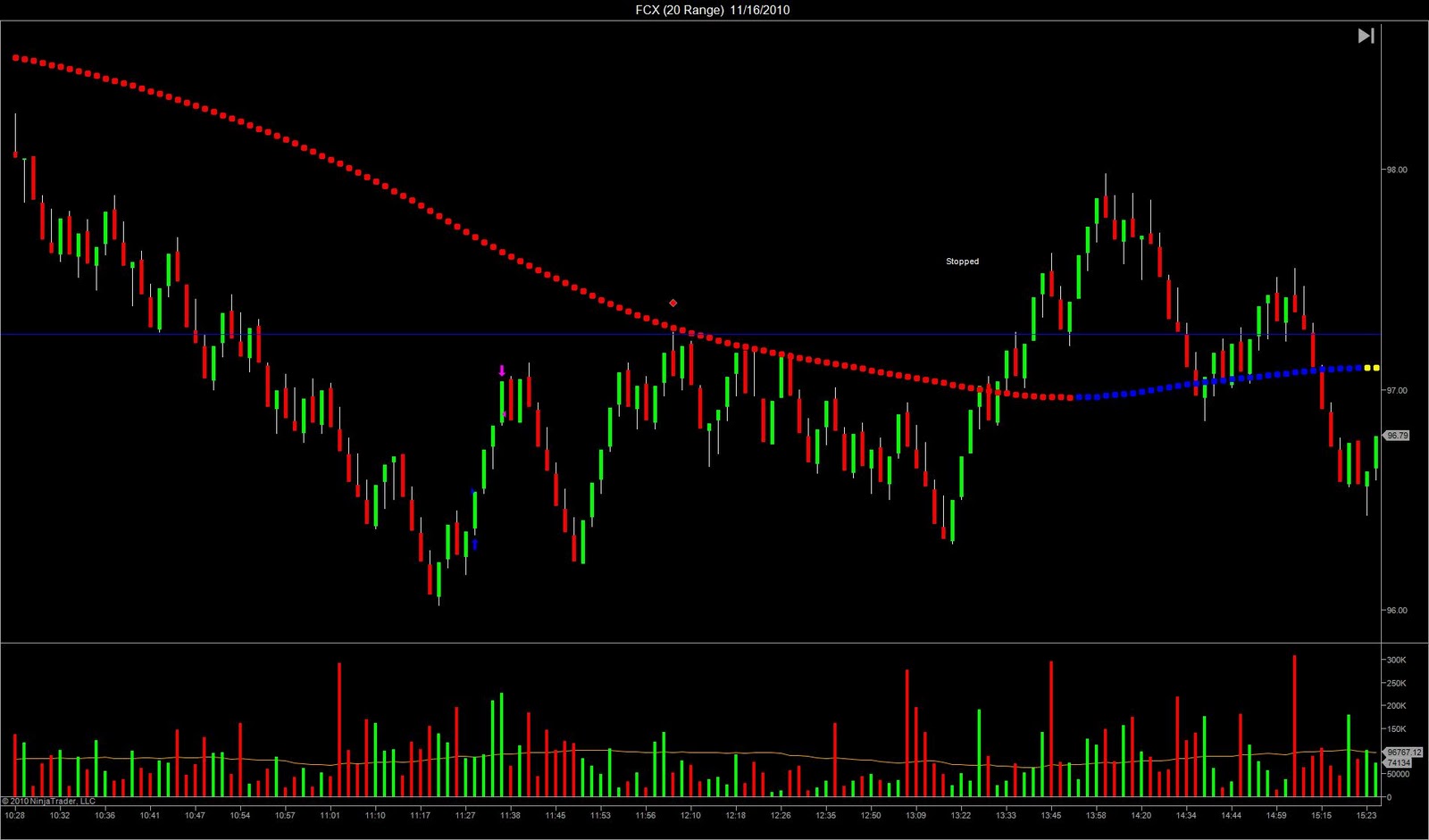
FCX


6 trades with 3 stops - but well over double the actual profit.

Final Thoughts


So far so good.

The bad thing? Well, perhaps not bad, but it was a little frustrating to realize that this is going to keep me out of some relatively big moves. For sure I have to be ok with this - I am coming to realize that missing big moves is likely and is not the end of the world. For now I have decided to accept that those moves and potential entry points are less probable.

Another question that comes to mind - what does this mean for my future as a trader? Am I limiting myself? Am I relying too much on indicators? Will this keep me from nurturing and relying upon my instinct?

I am not really sure. My hope is that this approach will make it 'safe enough' to continue to observe and learn. For the most part, the ability to grow my intuitive skills will have more to do with my attitude and how I see the 'technical framework': is this about safety and defining probabilities or is this about a rigid and conclusive methodology?

I have decided to 'test' this approach by trading live. As is evident from the two day review and the sometimes identical entries, this framework is a 'narrowing' of my current approach rather than a completely new ball of wax. The 'test' will mostly be about me and my ability to implement the trades with some degree of efficiency; i.e., trading the plan without exception. This will be the hardest part - and why I needed to address the psychological framework as well. Though it might sound a little silly, giving myself permission to be safe, lower my current expectations, and to continue to grow and learn, is a big step in the right direction.

Feedback appreciated.

Trade well.

Sunday, May 2, 2010

5 Steps to Becoming a Trader

This came up over at BTM's forum - source unknown. I thought it was a great read. I wouldn't be surprised to find out Scott posted it.


The 5 Steps to becoming a trader


Step One: Unconscious Incompetence.

This is the first step you take when starting to look into trading. you know that its a good way of making money because you've heard so many things about it and heard of so many millionaires. Unfortunately, just like when you first desire to drive a car you think it will be easy - after all, how hard can it be? Price either moves up or down - what's the big secret to that then - lets get cracking!

Unfortunately, just as when you first take your place in front of a steering wheel you find very quickly that you haven't got the first clue about what you're trying to do. You take lots of trades and lots of risks. When you enter a trade it turns against you so you reverse and it turns again .. and again, and again.

You may have initial success, and thats even worse - cos it tells your brain that this really is simple and you start to risk more money.

You try to turn around your losses by doubling up every time you trade. Sometimes you'll get away with it but more often than not you will come away scathed and bruised You are totally oblivious to your incompetence at trading.

This step can last for a week or two of trading but the market is usually swift and you move onth the next stage.

Step Two - Conscious Incompetence

Step two is where you realise that there is more work involved in trading and that you might actually have to work a few things out. You consciously realise that you are an incompetent trader - you don't have the skills or the insight to turn a regular profit.

You now set about buying systems and e-books galore, read websites based everywhere from USA to the Ukraine. and begin your search for the holy grail. During this time you will be a system nomad - you will flick from method to method day by day and week by week never sticking with one long enough to actually see if it does work. Every time you come upon a new indicator you'll be ecstatic that this is the one that will make all the difference.

You will test out automated systems on Metatrader, you'll play with moving averages, Fibonacci lines, support & resistance, Pivots, Fractals, Divergence, DMI, ADX, and a hundred other things all in the vein hope that your 'magic system' starts today. You'll be a top and bottom picker, trying to find the exact point of reversal with your indicators and you'll find yourself chasing losing trades and even adding to them because you are so sure you are right.

You'll go into the live chat room and see other traders making pips and you want to know why it's not you - you'll ask a million questions, some of which are so dumb that looking back you feel a bit silly. You'll then reach the point where you think all the ones who are calling pips after pips are liars - they cant be making that amount because you've studied and you don't make that, you know as much as they do and they must be lying. But they're in there day after day and their account just grows whilst yours falls.

You will be like a teenager - the traders that make money will freely give you advice but you're stubborn and think that you know best - you take no notice and overtrade your account even though everyone says you are mad to - but you know better. You'll consider following the calls that others make but even then it wont work so you try paying for signals from someone else - they don't work for you either.

You might even approach a 'guru' like Rob Booker or someone on a chat board who promises to make you into a trader(usually for a fee of course). Whether the guru is good or not you wont win because there is no replacement for screen time and you still think you know best.

This step can last ages and ages - in fact in reality talking with other traders as well as personal experience confirms that it can easily last well over a year and more nearer 3 years. This is also the step when you are most likely to give up through sheer frustration.

Around 60% of new traders die out in the first 3 months - they give up and this is good - think about it - if trading was easy we would all be millionaires. another 20% keep going for a year and then in desperation take risks guaranteed to blow their account which of course it does.

What may suprise you is that of the remaining 20% all of them will last around 3 years - and they will think they are safe in the water - but even at 3 years only a further 5-10% will continue and go on to actually make money consistently.

By the way - they are real figures, not just some ive picked out of my head - so when you get to 3 years in the game dont think its plain sailing from there.

I've had many people argue with me about these timescales - funny enough none of them have been trading for more that 3 years - if you think you know better then ask on a board for someone who's been trading 5 years and ask them how long it takes to become fully 100% proficient. Sure i guess there will be exceptions to the rule - but I havent met any yet.

Eventually you do begin to come out of this phase. You've probably committed more time and money than you ever thought you would, lost 2 or 3 loaded accounts and all but given up maybe 3 or 4 times but now its in your blood

One day - im a split second moment you will enter stage 3.

Step 3 - The Eureka Moment

Towards the end of stage two you begin to realise that it's not the system that is making the difference. You realise that its actually possible to make money with a simple moving average and nothing else IF you can get your head and money management right You start to read books on the psychology of trading and identify with the characters portrayed in those books and finally comes the eureka moment.

The eureka moment causes a new connection to be made in your brain. You suddenly realise that neither you, nor anyone else can accurately predict what the market will do in the next ten seconds, never mind the next 20 mins.

Because of this revelation you stop taking any notice of what anyone thinks - what this news item will do, and what that event will do to the markets. You become an individual with your own method of trading
You start to work just one system that you mould to your own way of trading, you're starting to get happy and you define your risk threshold.

You start to take every trade that your 'edge' shows has a good probability of winning with. When the trade turns bad you don't get angry or even because you know in your head that as you couldn't possibly predict it it isn't your fault - as soon as you realise that the trade is bad you close it . The next trade or the one after it or the one after that will have higher odds of success because you know your system works.

You stop looking at trading results from a trade-to-trade perspective and start to look at weekly figures knowing that one bad trade does not a poor system make.

You have realised in an instant that the trading game is about one thing - consistency of your 'edge' and your discipline to take all the trades no matter what as you know the probabilities stack in your favour.

You learn about proper money management and leverage - risk of account etc etc - and this time it actually soaks in and you think back to those who advised the same thing a year ago with a smile. You weren't ready then, but you are now. The eureka moment came the moment that you truly accepted that you cannot predict the market.


Step 4 - Conscious Competence


You are making trades whenever your system tells you to. You take losses just as easily as you take wins You now let your winners run to their conclusion fully accepting the risk and knowing that your system makes more money than it looses and when you're on a loser you close it swiftly with little pain to your account

You are now at a point where you break even most of the time - day in day out, you will have weeks where you make 100 pips and weeks where you lose 100 pips - generally you are breaking even and not losing money. You are now conscious of the fact that you are making calls that are generally good and you are getting respect from other traders as you chat the day away. You still have to work at it and think about your trades but as this continues you begin to make more money than you lose consistently.

You'll start the day on a 20 pip win, take a 35 pip loss and have no feelings that you've given those pips back because you know that it will come back again. You will now begin to make consistent pips week in and week out 25 pips one week, 50 the next and so on.

This lasts about 6 months

Step Five - Unconscious Competence

Now we’re cooking - just like driving a car, every day you get in your seat and trade - you do everything now on an unconscious level. You are running on autopilot. You start to pick the really big trades and getting 200 pips in a day doesnt make you any more excited that getting 1 pips.

You see the newbies in the forum shouting 'go dollar go' as if they are urging on a horse to win in the grand national and you see yourself - but many years ago now.

This is trading utopia - you have mastered your emotions and you are now a trader with a rapidly growing account.

You're a star in the trading chat room and people listen to what you say. You recognise yourself in their questions from about two years ago. You pass on your advice but you know most of it is futile because they're teenagers - some of them will get to where you are - some will do it fast and others will be slower - literally dozens and dozens will never get past stage two, but a few will.

Trading is no longer exciting - in fact it's probably boring you to bits - like everything in life when you get good at it or do it for your job - it gets boring - you're doing your job and that's that.

Finally you grow out of the chat rooms and find a few choice people who you converse with about the markets without being influenced at all.

All the time you are honing your methods to extract the maximum profit from the market without increasing risk. Your method of trading doesnt change - it just gets better - you now have what women call 'intuition'
You can now say with your head held high "I'm a currency trader" but to be honest you dont even bother telling anyone - it's a job like any other.

I hope youve enjoyed reading this journey into a traders mind and that hopefully youve identified with some points in here.

Remember that only 5% will actually make it - but the reason for that isnt ability, its staying power and the ability to change your perceptions and paradigms as new information comes available.

The losers are those who wanted to 'get rich quick' but approached the market and within 6 months put on a pair of blinkers so they couldnt see the obvious - a kind of "this is the way i see it and thats that" scenario - refusing to assimilate new information that changes that perception.

I'm happy to tell you that the reason i started trading was because of the 'get rich quick' mindset. Just that now I see it as 'get rich slow'

If you're thinking about giving up I have one piece of advice for you ....

Ask yourself the question "how many years would you go to college if you knew for a fact that there was a million dollars a year job at the end of it?

Take care and good trading to you all
.

Thursday, January 7, 2010

Charts and stuff (1-17-2010)


As I have been posting entries, changing blog formats, and thinking about how I want all of this to eventually look, I thought that an entry dedicated to more in-depth, yet still casual, review would be kind of cool. Hence this post.

Below find what are mostly charts documenting various metrics on the account. This will be periodically - or rather - non-periodically updated to keep everyone more or less up to date.

Expect the content on this entry to change as I keep thinking about it. Feel free to make specific requests as well.


The next three charts plot the percent change realized on a stock after it met the buy screener criteria - in other words, if I was able to buy all of the stocks the day they met the buy criteria, gains would match the pretty little red - and uptrending - line (the average)on the first chart. The second and third charts show the performance of the stocks that were either above or below the average gain value on day 10 of ownership.


(Above Average at Day 10)


(Below Average at Day 10)
 
The next two charts are new to this week - I am thinking I will be using them for part of my sell criteria, but not sure how all that will work out yet. The data is filtered for every day positive and every day negative in each chart respectively.


(Positive every day)

 
(Negative every day)