"An expert is a man who has made all the mistakes which can be made, in a narrow field."

- Niels Henrik David Bohr
Showing posts with label mistakes. Show all posts

Sunday, November 21, 2010

Weekend Edition (11-20-2010)

I have noticed that I have at least two bad entry habits that consistently eat into the daily profits:

  • Entering on a non-moving stock
  • Exiting early on a big trend and trying to reverse

I decided to spend part of the weekend trying to come up with an approach that would reduce my tendency to trade those types of price environments. While realizing the problem over the last week or so, and trying to figure out a solution, it became painfully obvious that my current simple/naive approach to establishing entries/exits doesn't offer much in the way of discretionary tools.

I thought about it. And thought about it some more. And then I decided that I really needed to come up with  an objective and quantifiable 'something or other' as an indicator of the current price environment. Something to give me the 'green light' to look for an entry.

So I came up with two ideas - one addressing my psychological framework, and one addressing my technical framework.

As to the psychological framework


This is the most important thought of the weekend.

I feel that I need to be ready to admit that I cannot trade like Scott; as much as I would like to be able to, and hopefully eventually will be able to, it is way beyond my current skill level. Scott has an amazing sense for the trade, honed by years of experience and an ability to focus. Sometimes I do very well reading momo, but there are enough times (as evidenced over the last few weeks of live trading) where I fall pretty flat and rapidly cut into my profits

After I stopped to think about some of this, I was surprised at how often 'pretending to be as good as Scott' gives me permission to make some entries. What I mean to say is he is able to time exits and reversals so un-canningly perfect at times that I think I should be able to as well: 'This looks right, I am just going to go for it and see what happens.' In a way, admitting this is about giving myself permission to slow down, lowering some immediate expectations, and taking more time and thought to analyze/observe price environments.

As to the technical framework


I wanted to keep this as simple and naive as possible. In a nutshell - I decided to go with the trend and the big movers. I am going to limit trades to big movers and use the color of the MA's on both the short and longer ranges as the quantifiable measure of the trend.


Entries
  • Do not trade prior to 10:00 a.m. ET.
  • Limit trades to the 5 stocks with the highest ATR values.
  • Only trade in the color direction of both the short and long range charts (blue is long, red is short)
    • Enter when the price crosses the short range MA, with the color of the short range MA matching the long range MA
    • Watch for end of trend signals:
      • Extremely high/low volumes, wave count (5/3 wave)
  • Place stops on the closest prior S/R


Exits

  • Draw lines from the start of the move to the top/bottom of the first correction for exits
    • Draw a new line if the slope of the trend changes
    • Exit when a bar on the dominating chart closes below the line 
  • Watch for end of trend signals:
    • Extremely high/low volumes, wave count (5/3 wave)

Here is an example of a legitimate trade on AAPL: 


Yellow lines are the wave count, red lines are exit lines, red diamond is entry, red dot is exit. Here is the setup on the 20 range (which, in my current setup is the shorter of the two range bars):

Entry:


Exit:


For a quick comparison - here are my trades on the 45 for the same day:


The same initial entry, but only one rather than 6 - only 3 of which did not get stopped out.


Reversals (i.e., trading against color on the larger range)

  • Only trade against color on the larger range when there is extreme high/low volume changes on the shorter range, and after the shorter range crosses the MA.

Here is a legitimate reversal on AAPL (11-16-2010)


Entry (note extreme volume at LOD):


Exit:


How This Compares


I picked two days worth of trades over that last couple of weeks: 11-10-2010 (i.e., the biggest losing day) and 11-16-2010 9the biggest winning day). I assumed that I would of been watching the same stocks and entered accordingly.

11/10/2010

There were no trades on TNA, RIMM, BIDU, SOHU,  PEGA, or GS using the probability criteria.

AAPL:

This was probably the most problematic of the bunch - especially with respect tot he 5/3 wave configuration. I kept the basic rules - and decided that the start of the new wave had to have at least 2 candles closing below the low of the peaking candle (of course it would be the opposite in a down trend).

The entry is at the start of wave 4 on the 45.


AIZ


CF


CMG


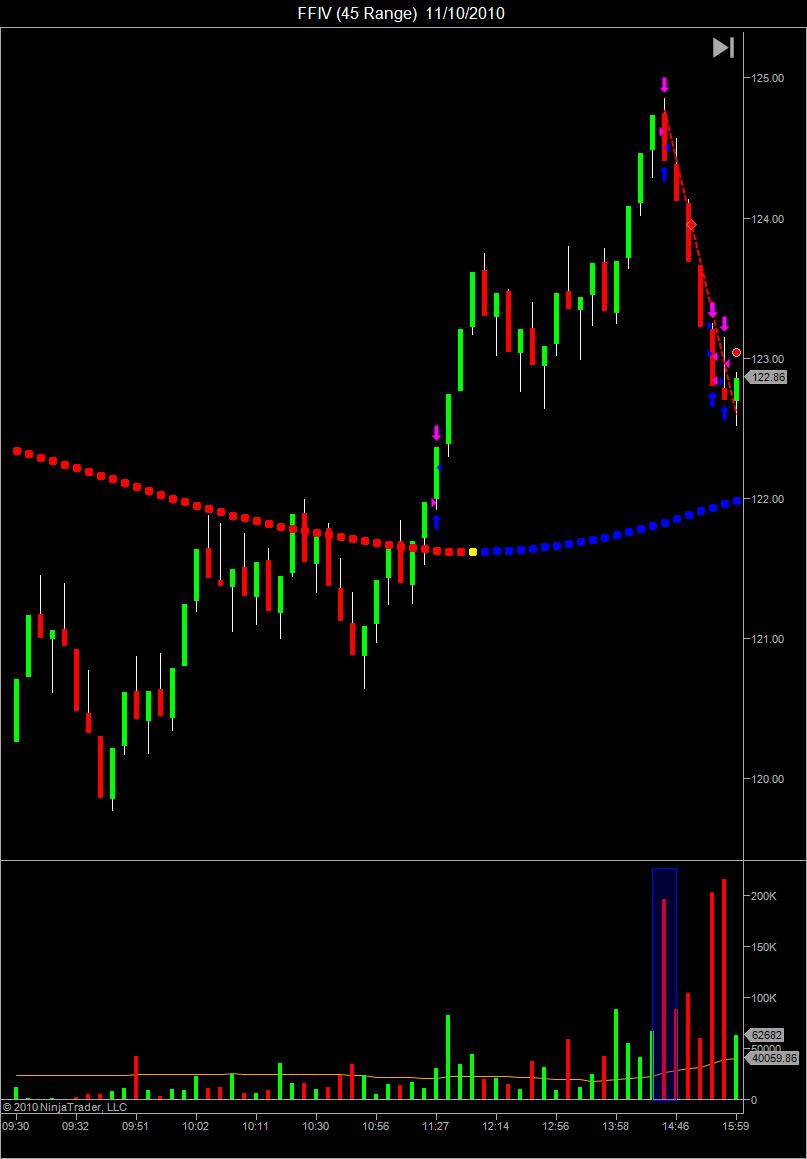
FFIV


NFLX

Two trades on NFLX.


Trade 1:


Trade 2 entry:


Trade 2 exit:


 PCP


2 stops on 8 trades, 6 trades were very profitable; compared to what NT calls 53 entries and exits.Of course this is no guarantee of what I would of actually done, but it is about as close as I can get.

11/16/2010

AAPL

Two trades on AAPL.

Again the 5/3 wave definition was a little problematic - but the fuscia line holds as wave 3 cannot be the shortest. Two of the corrective waves are on the verge of not being corrective at all, so it could of gone either way.


Trade 1:


Trade 2:


BIDU


CMG

Two trades on CMG.


Trade 1:


Trade 2 - stopped:


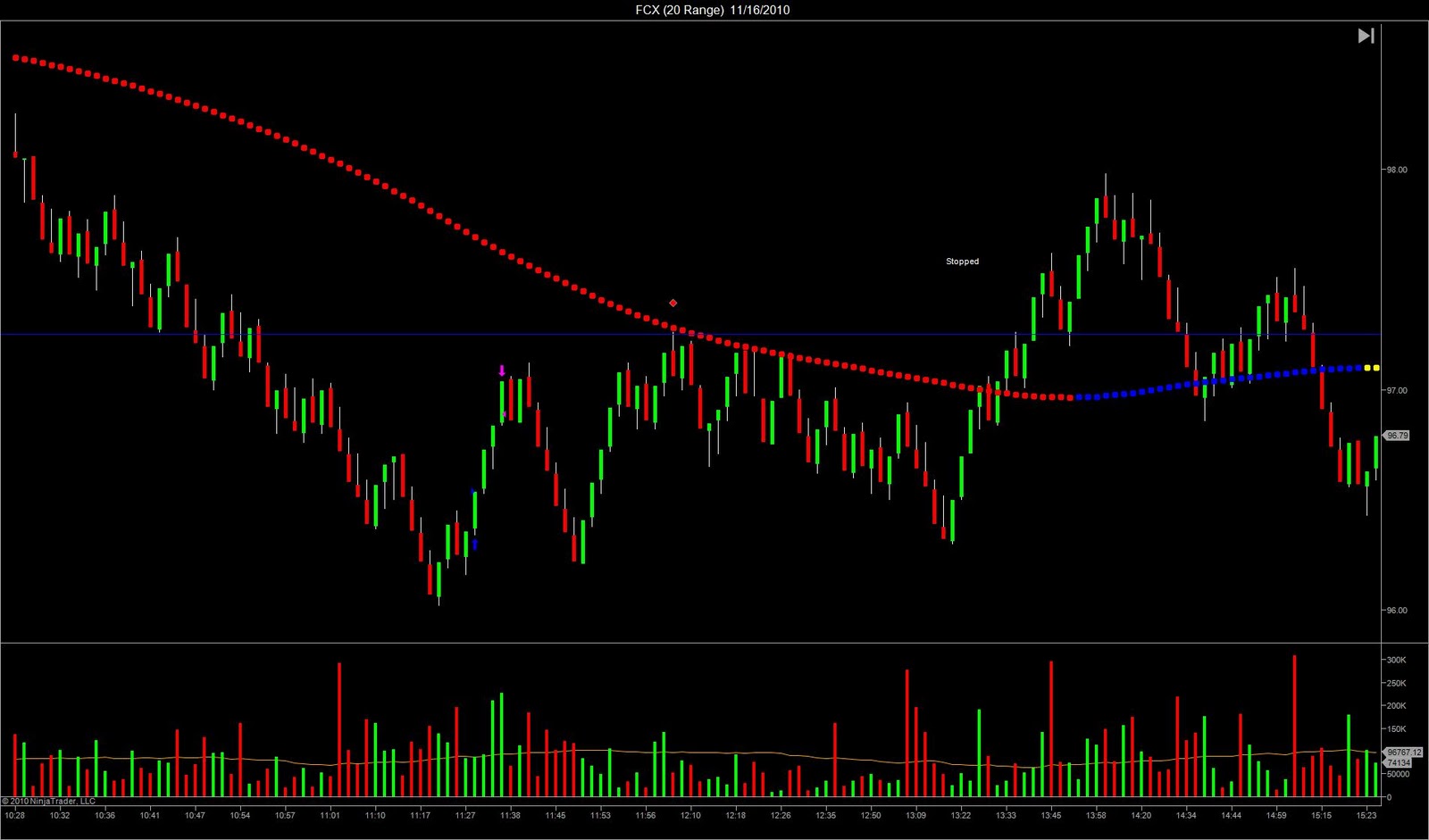
FCX


6 trades with 3 stops - but well over double the actual profit.

Final Thoughts


So far so good.

The bad thing? Well, perhaps not bad, but it was a little frustrating to realize that this is going to keep me out of some relatively big moves. For sure I have to be ok with this - I am coming to realize that missing big moves is likely and is not the end of the world. For now I have decided to accept that those moves and potential entry points are less probable.

Another question that comes to mind - what does this mean for my future as a trader? Am I limiting myself? Am I relying too much on indicators? Will this keep me from nurturing and relying upon my instinct?

I am not really sure. My hope is that this approach will make it 'safe enough' to continue to observe and learn. For the most part, the ability to grow my intuitive skills will have more to do with my attitude and how I see the 'technical framework': is this about safety and defining probabilities or is this about a rigid and conclusive methodology?

I have decided to 'test' this approach by trading live. As is evident from the two day review and the sometimes identical entries, this framework is a 'narrowing' of my current approach rather than a completely new ball of wax. The 'test' will mostly be about me and my ability to implement the trades with some degree of efficiency; i.e., trading the plan without exception. This will be the hardest part - and why I needed to address the psychological framework as well. Though it might sound a little silly, giving myself permission to be safe, lower my current expectations, and to continue to grow and learn, is a big step in the right direction.

Feedback appreciated.

Trade well.

Friday, January 1, 2010

My trading history - as of 12/31/2009

I suppose all of this counts for experience, so in some sense, I could almost say that I now have about 10 years of stock market experience, but as sporadic as it was for several years, that would be a little misleading.

Lemme preface by saying that I have probably broken every good trading rule in the book, if I have missed any, I will probably get around to it tomorrow.

My stock market trading began in the late summer/fall of 2000. I took $2500 out of savings and opened up a Datek account. My knowledge of the stock market at the time was virtually null: maybe 2 or 3 articles regarding the insane amounts of money some people were making in the stock market. Oh yeah, that and the fact that my brother-in-law had seen the value of one of the mutual funds he was invested in grow something like 100% a year for the last 3 years. I figured I could afford to lose the $2500, so I just dove in to see what would happen.

Somehow I managed to select a few stocks to trade in and ended making several trips in and out - the majority of transactions in Webvan. Within 2 weeks I had tripled my initial investment. And (I have to remind myself) this was real money, not just account value - at the end of the week I actually had the money out of all the stocks and sitting in the money market account. Whoot! I remember thinking either this was incredibly easy or that I must be incredibly brilliant. The problem was, I really didn't know what to do with the money except more of the same. Since I had made most of my money in Webvan, I stuck everything back in. Within the next week Webvan had announced bankruptcy and I lost something like 50% of my account value. I decided to take a bit of a breather and try to learn more about market dynamics.

Over the course of the next couple of years I sporadically read several different books (my favorites being from the 'The Idiot's Guide ...' and '... for Dummies' series) and tried several different strategies But nothing seemed to work very well for the amount of time and effort that I was willing and able to invest. I became convinced that my best investment strategy invovled mutual funds - capitalizing on the experience and opinions of professional, full time people with a lot more knowledge of the market. I bought some GOOG and stuck the rest in mutual funds. That was pretty much it for 5 or 6 years. Every once in awhile I picked up another book and read it, but after each one I would come to the conclusion that I just did not have the time it took to profitably invest.

In the spring of 2009 I happened to take a class in engineering entrepreneurship as part of my doctorate curriculum. Our professor stressed the importance of a familiarity with the stock market for wannabe entrepreneur's - 'The stock market is the real world of money, and you need to know what people are choosing to value in order to be a good entrepreneur.' He started each class with a 30-minute talk/presentation of the day's market activity. My first reaction was: 'Been there and done that, can't beat the professionals'. But seeing some of the day's activity up on the class projector week after week got me thinking and dreaming again: 'A lot of stocks see a 5% movement in a day, if I could just capture half of that...'

By the middle of the semester I had picked up another couple of books, one on candlestick charting and a second on technical analysis. Seeing as I still had the Ameritrade account (somewhere along the line Datek had been purchased by TD Ameritrade if I remember correctly) I gained some familiarity with their StrategyDesk application and became enraptured with the back-testing routine. Really cool tool - but what a learning curve. I re-call my first successful and virtually profitable back-test run. All I could think about the rest of the day - how much money this was going to roll in, and how in the world I was going to protect this strategy after the folks at Ameritrade realized that one of their StrategyDesk users was amazingly successful. That lasted until I realized that telling the backtesting app to sell the stock on the condition that the price is within 1% of the high for the day works differently for a closed day versus a live yet-to-unfold day. Fun stuff.

By the time I had settled on a strategy I was chomping at the bit to see if it really worked. I decided to transfer one of our IRA's out of a mutual fund into the Ameritrade IRA. As the account was an IRA, I could not set the account up for margin, which limited the funds to one in and out trade within a three day period (e.g., unless the buy-sell exceeded 3 days, the funds would not be available for immediate re-investment). For the next three months I kept track of all the potential trades (using the alert window) and at the end of the day I was able to look at the 'What if I had been able to trade this stock?' scenarios. I had a few good days, but overall this ended up being an exercise in frustration - my buys and sells netted a ~30% loss and the 'what-ifs' netted substantial profits.

By then end of the 3 months I came to the conclusion that my strategy was good, but I was just not able to trade often enough to net a profit (I was going all in with each purchase to keep the transaction fees relatively small, and was only able to trade 2 times a week at most). So I opened up a standard margin trading account with $30,000.

I made $1000 the first day of trading, and $800 the next. But by the end of the week I had lost $7000: $5000 of the initial investment, and the $2000 I had gained. The following week saw another $2000 loss. In order to meet margin requirements and continue intraday trading, I had to invest another $2500 in the account ($25000 minimum equity). Then another $1600 after additional losses. Ouch.

I slowed down my trading frequency and examined, re-examined, and re-re-examined my strategy. I found out a lot about myself and the market over the next 3 months. I came to realize that I can get very emotional about a trade, that I have a hard time following my own rules, and that I was berift of any trading intuition. A couple of valuable lessons: no matter how amazing, useful and successful the back-testing and real time alert data was, for a strategy to actually work there had to be someone at the other end of the trade: someone to actually sell the full amount of shares that I wanted to buy at the price I wanted to buy them at, and someone willing to buy all of the shares that I had for sale at the price I wanted to sell them at - all within the hypothetical trade interval. I also realized that my personal purchase and sale of a stock - or even my personal offering to buy or sell - can have real impact on the immediate price action.


All of this contributes to my current market philosophy and applied trading strategy, which has met with some success over the last 2 months. As applied over the last two months of the year, I have realized a net positive increase in the account, over probably about 20 trades - not as exciting or flashy as >$800 in under a minute, and definitely not something to move to Costa Rica on, but moving in the right direction. New Year's Eve saw the account close at $26025.74, with approximately 44% of the portfolio still invested in 3 stocks. Based on the account value at the beginning of November, this amounts to about a $1800 increase for the last two months, or about 9%.

Current figures are posted on the blog sidebar (as of January 4, 2010).